Project Description
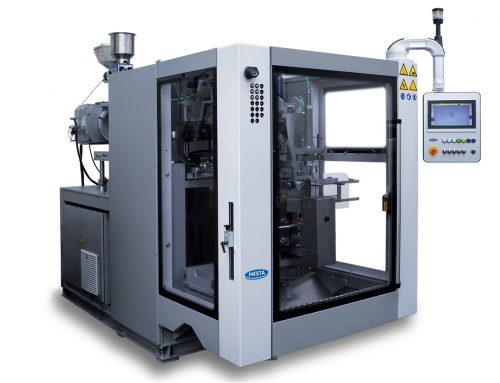
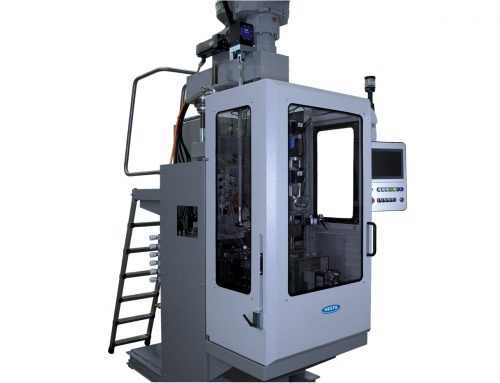
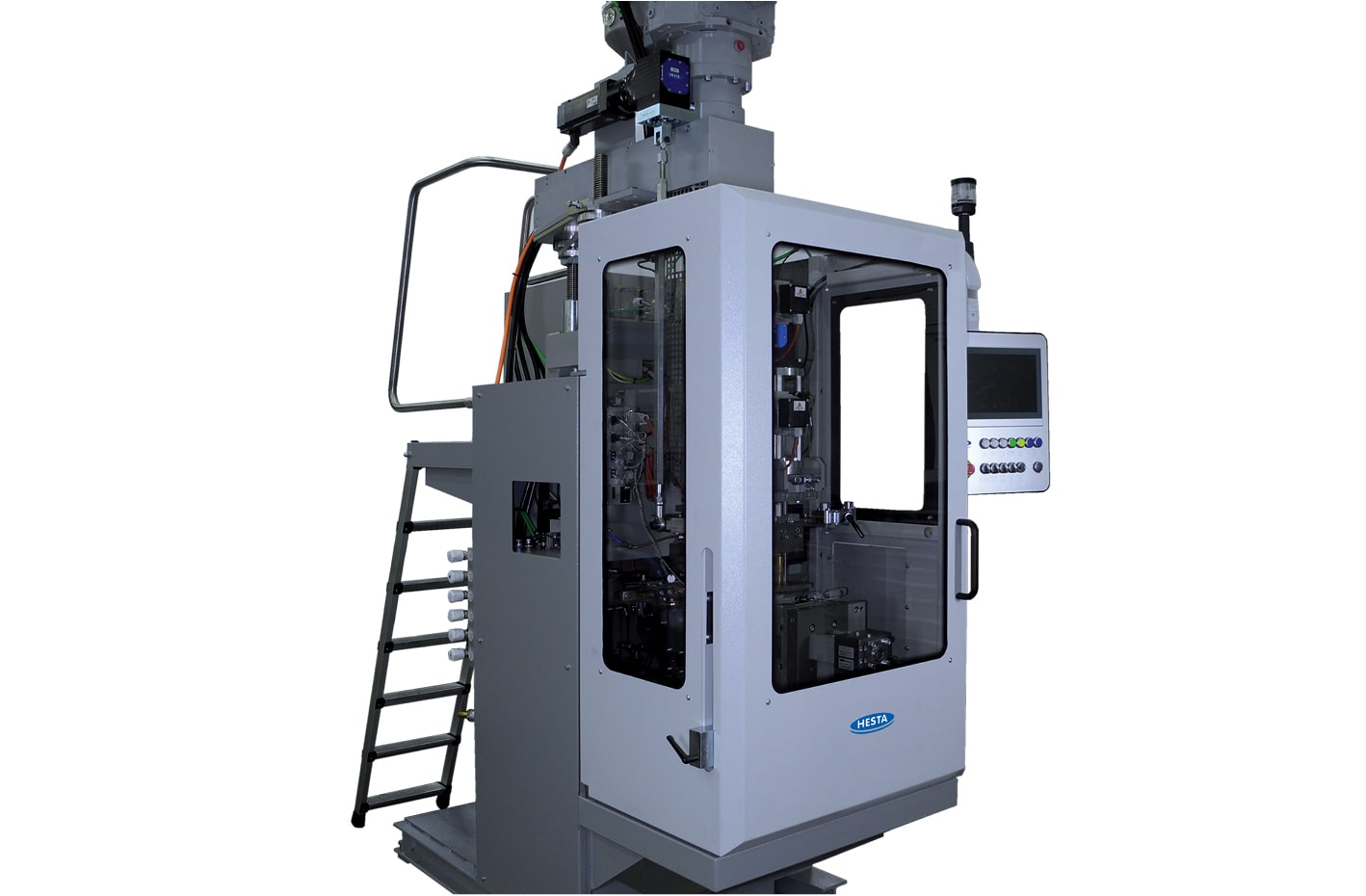
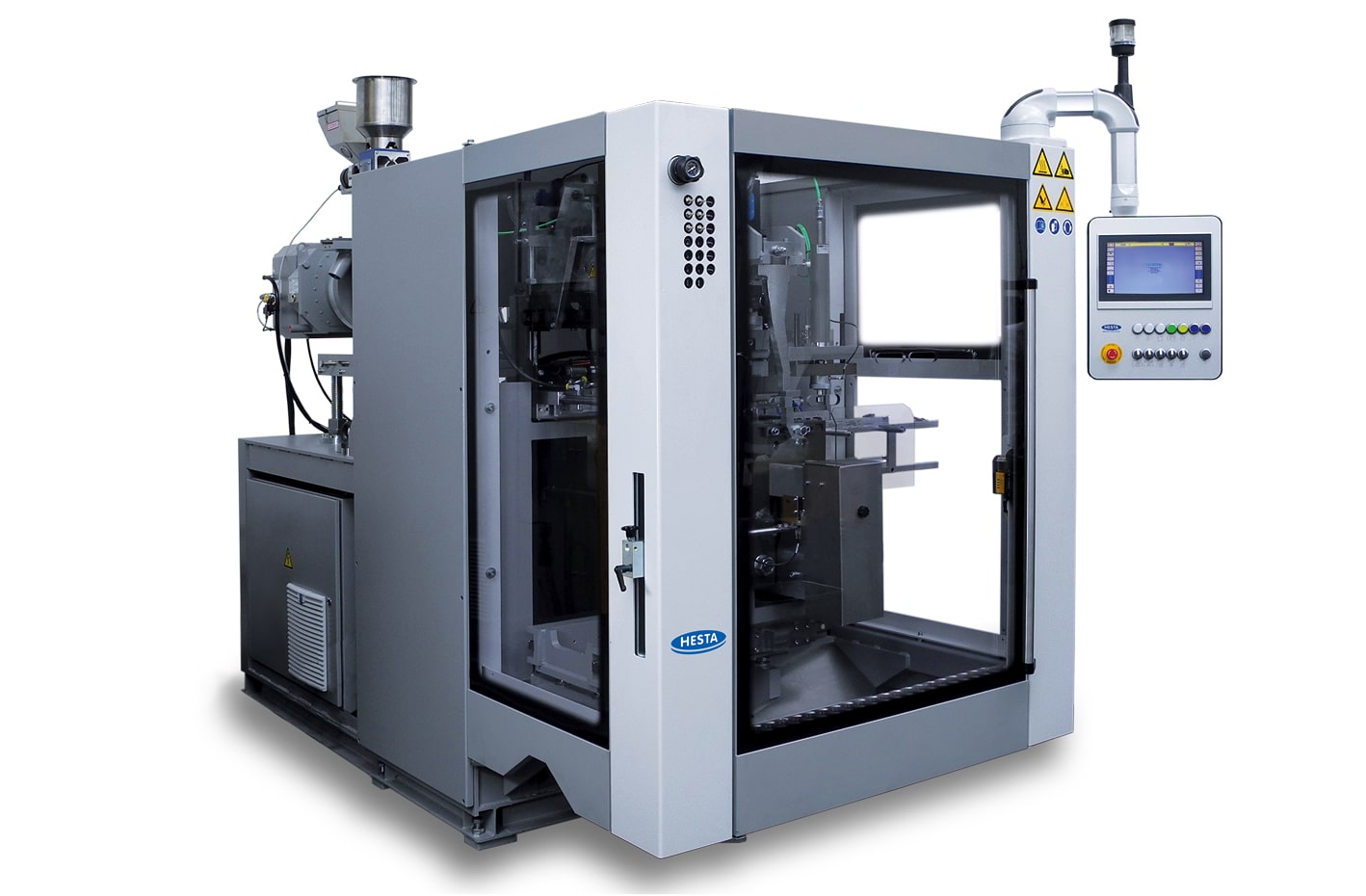
HM360E
Detailed description
When blow molding various bottle packagings and batch sizes, the new HESTA blow molding machines of the HM and HMD series operate flexibly and efficiently. With a capacity of up to 6 or 2×6 bottles per cycle, they rank among the most cost-effective machines. The basic version includes the essentials for hollow body production, with expansion options for testing, post-processing, and transport. This ensures you only pay for what you actually need.
Subsequent stations are possible right from the start on all machines. Cost-effective holding mandrels or a testing device with a transfer function can be integrated directly within the station. The production sequence from the extruder to product discharge takes place on a single plane from left to right at the front of the machine. The optimal accessibility for the set-up technician saves you time and adjustment effort. We offer the appropriate machine technology for every desired degree of automation and with variable options for downstream processing.
Your advantages:
- High flexibility through rapid mold changes: from 1-cavity up to 6-cavity molds
- High output performance
- Extruder heads in a proven design
- Energy-saving, high-performance extruder with a globally unique extruder drive
- Short changeover times thanks to directly flange-mounted transfer units
- High service life with precise mold guidance through an open clamping system with direct
Clamping force application without bending stress on the guide columns
- Safe single-side discharge of tested bottles via dual-station transfer units on the mold for the single-station version, left & right for the dual-station machine, or also directed to one side with a height-adjustable conveyor belt.
- Variable transfer options to downstream stations
- Low adjustment effort as no transport rails are required
- Universally equipped with post-cooling station, rotary cutter, and bottle tester
- Convenient machine operation
- Small footprint due to a very compact, open design with excellent accessibility
- Favorable price-performance ratio combined with high new HESTA quality standards
Detailed description:
Ready for anything: Our universal extruder
The universal extruder is arranged horizontally. Patented, interchangeable feed bushings that can be removed from the side simplify and shorten setup times. The extremely complex dismantling of the extruder drive and the subsequent pressing out of the feed bushing are completely eliminated with new HESTA! This makes it the only true universal extruder worldwide, allowing the use of all blow-moldable materials in powder or granulate form, with or without regrind admixture. Speed control allows the machine's cycle time to be kept constant. Depending on the material, appropriate screws with or without a mixing section are used. The unique extruder drive is not only energy-saving but is powered by four individual motors. This enables the simple replacement of a single motor and also allows emergency operation or operation at reduced power while a single motor is being repaired.
Our wall thickness control:
The electronic parison wall thickness control with a maintenance-free crank drive is mounted directly on the extruder, ensuring it remains on the machine even during a head change. This allows for extremely short changeover times and low acquisition costs for an additional extrusion head. The wall thickness is pre-programmed across the entire parison length using 100 points, which can be entered manually or drawn in. The timing sequence adapts automatically to the cycle time of the blow molding machine.
Our extrusion head:
A finely graduated selection of extrusion heads is available in single or multi-cavity designs, mono or multi-layer configurations, and with spider, pin-type, or spiral mandrel designs for all standard nozzle spacings. Our unique Vario heads can be retrofitted from the original mono head to a sight stripe or DeCo2 head simply by replacing a feed plate. This flexible and cost-effective retrofit is unique worldwide.
Parison cutter:
Cold and hot cutting systems are available for severing the parison. These are pneumatically driven, but can also be upgraded with our unique electric high-speed knife. Operating at speeds of up to 12 m/s, this knife cuts the parison before it can shift, thereby keeping parison curling to a minimum. The portfolio is rounded off by our parison closing and cutting device with controlled support air. Immediately after the parison cutting process, the extruder is raised in the head area by means of a maintenance-free crank mechanism, while the hopper or any attached feeding units remain unaffected and stationary thanks to the unique ball socket.
Shaping with air: Our blow heads:
The universal blow head enables economical and time-saving multi-cavity blow molding – from 1-fold to 6-fold. The number of individual pre-assemblable blow pins depends on the number of mold cavities. Calibration is performed electrically using a maintenance-free crank mechanism with 13 kN of calibration force. The universal blow head is securely guided on both sides; the patented calibration cushion ensures simple zero-point calibration of the blow pin height relative to the parting edge in the mold, as well as a reproducible set calibration force in every cycle. The universal blow head permits 1-cavity to 6-cavity blowing. It can be set up for all available nozzle spacings via positioning keyways. Large cross-sections ensure sufficient air volumes. The blow pins are water-cooled right up to the tip. Angled calibration is also an option.
Directed transfer:
The blown articles are removed from the blow pin by masks attached directly to the blow mold and transferred to a single plane of the downstream station. This eliminates the need for manual alignment and setup, resulting in dramatic savings in changeover times. Double masks can be used to serve an additional downstream station (e.g., for leak testing). This handling process ensures optimal cooling of the hollow bodies and increases output performance. Neck and bottom flash, as well as handle scrap, are removed by pneumatic punching cylinders.
new HESTA’s unique mold change concept:
As a new feature, the machine is equipped with a patented blow molding and deflashing system. Essential tool parts, such as the blow mold/mask and punching units, can be replaced with minimal effort and without readjustment during a retooling process. The transfer masks designed for multiple downstream stations are attached directly to the corresponding mold halves. The tool parts required for post-processing fit into the machine-side standardized receptacles with the highest precision. As a result, both the blow mold-mask unit and the tool parts in the downstream stations can be exchanged from machine to machine with minimal effort and without requiring readjustment during subsequent setups. The blow pins are pre-assembled in their mounts so that they can be installed easily and quickly during tool changes. Thanks to this modern tool-change technology, conversion times are significantly reduced, setup work and the one-time adjustment of punching tools are facilitated, and overall machine efficiency is increased. The machine is equipped with the proven 2-circuit cooling system with direct cooling water supply via the clamping plates and O-ring sealing.
Open and close, back and forth: Our clamping system:
The open C-frame clamping system with two lower tie bars has an infinitely adjustable clamping force of up to 60 kN / 80 kN and is likewise driven by a maintenance-free crank mechanism, along with an adjustable mold opening stroke. The tie bars are not subjected to bending stress and therefore ensure precise guidance of the clamping plates; a unique feature is the return of the cooling water through the tie bars themselves. The patented clamping cushion enables you to automatically calibrate the mold thickness within ± 5 mm, and the clamping force can also be optimally adjusted to your article in set-up mode. Human setup errors are ruled out with new HESTA. If the machine detects a minimal deviation during production, it immediately performs an automatic set-up and adjusts the clamping force. The blow mold is freely accessible. The lightweight design results in low moving masses and thus short cycle times. Two separate cooling circuits are available in each clamping plate, and the integrated cooling circuit connection through the clamping plates not only contributes significantly to rapid changeovers but also prevents misconnections. To facilitate tool changes, an additional side door is fitted to the safety enclosure. Here, as with all other components, the latest safety recommendations have been incorporated.
Energy-saving drives: Our electric drives and pneumatics:
Energy-efficient servo drives power the extrusion unit, the shifting and clamping movements, as well as the calibration unit. The associated Beckhoff servo drives always represent the latest generation, enabling economical production through optimal adjustment of energy consumption to machine utilization. The pneumatics control the blowing, cooling, transfer, punching, and ejection functions using proven, sophisticated components. The standard pneumatic valves are arranged in a service-friendly manner on a central base plate.
Control cabinet & control system:
The electrical control cabinet is vibration-damped, easily accessible, and mounted on the machine in a service-friendly manner. The programmable logic controller with a front-mounted panel meets the highest standards of reproducibility—simple, secure, and clearly structured. It allows for the individual input of all setpoints for motion sequences, heating, and wall thickness control, as well as the integrated bottle tester. An internal background memory facilitates setpoint optimization. All inputs and error messages are displayed in plain text. The warning and monitoring systems included in the standard equipment monitor the entire machine process. In the basic version, four authorization levels prevent unauthorized inputs, and personalized login can optionally be activated. Inputs and all error messages are logged for process traceability. Two monitor sizes are available depending on the machine type for ease of operation. The colored 12-inch and 21-inch touch panels are directly connected to the Windows-based modular control system. Any number of setpoint datasets can be stored in the internal memory or conveniently transferred to an external storage medium via a USB port. This shortens changeover times—especially for small batch sizes—and increases cost-effectiveness. All common languages can be switched quickly and easily. Preparation for online service is a matter of course for us and can be easily implemented using pre-installed software.
If you want more: Our auxiliary equipment
- The fully automated production of wide-neck containers is carried out using circular cutters with an optionally electrically or pneumatically actuated, revolving knife to remove the flash outside the mold in the trimming station, with horizontal or vertical cutting possible.
- The fully integrated bottle tester is used for leak testing and neck inspection. This can optionally be expanded with a neck passage inspection. Defective items are thus prevented from being passed on and drop directly onto the flash scrap conveyor. Since 100% tested bottles are discharged from the machine, customer complaints about leaking bottles are a thing of the past.
Get in touch
Do you have any questions?
new HESTA blow moulding solutions GmbH & Co. KG
Address
Werrenwiesenstraße 89
D-73525 Schwäbisch Gmünd
info@hesta.de
support@hesta.de
Telephone & Fax
Tel. +49 (0) 71 71 / 99 790 – 0
Fax +49 (0) 71 71 / 99 790 – 13
Daniel Knabel
Deputy Management, Technical Director, Key Account
Telephone +49 (0) 71 71 / 99 790 – 10
knabel[at]hesta.de